
Last week, we talked about how a Revocable Living Trust is essentially "invisible" to the IRS while you're alive. But if you've opted for an Irrevocable Trust—often used for Medicaid Asset Protection (MAPT) or high-level estate tax planning—the rules of the game change.
In this world, the EIN is king.
The Magic of the EIN
An Employer Identification Number (EIN) is essentially a Social Security number for an entity. When a trust becomes irrevocable, it usually moves away from using your personal SSN.
-
The Difference: By getting an EIN, you are telling the IRS and New York State that this Trust is a separate legal person.
-
Why it Matters: This separation is exactly what provides the "shield" for Medicaid eligibility and creditor protection. If the IRS sees it as a separate entity, so do the nursing homes and the courts.
Grantor vs. Non-Grantor: The Tax Twist
Just because a trust has its own EIN doesn't always mean it pays the taxes. This is where strategic planning comes in.
1. Grantor Irrevocable Trust (The Medicaid Favorite)
Many MAPTs are structured so that even though the trust is irrevocable, you (the Grantor) still pay the income taxes on your personal return.
-
The Benefit: This is actually a "gift" to your heirs! By paying the taxes yourself, you allow the Trust assets to grow untouched, effectively moving more wealth to your children without using up your lifetime gift tax exemption.
2. Non-Grantor Trust (The Independent Entity)
A Non-Grantor Trust is treated as a completely separate taxpayer. To achieve this, you must relinquish all control—you can't change beneficiaries or manage assets for your own benefit.
-
Why choose this? It's a "SALT" solution. Because the trust is a separate taxpayer, it gets its own $10,000 state and local tax deduction, potentially multiplying your tax-saving power. It's also great for shifting income to beneficiaries in lower tax brackets.
Filing the Paperwork: NY vs. Federal
Once a trust is its own entity, the paperwork gets a bit more formal.
-
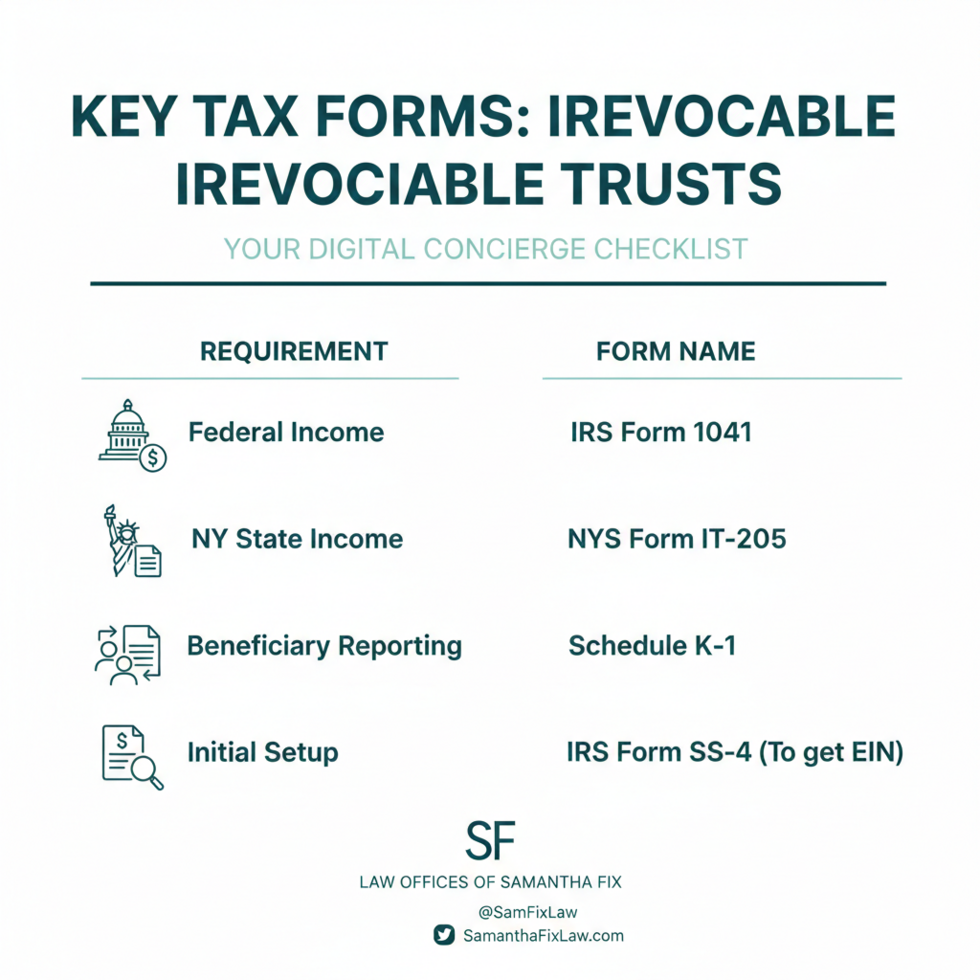
Federal Level (IRS): You must file Form 1041. If the trust distributes income, it issues a Schedule K-1 to beneficiaries so they can report their share on their own taxes.
-
New York State Level: You must file Form IT-205. New York is famous for its "Resident Trust" rules; if you were a NY resident when you created it, the state generally wants to tax the income regardless of where the Trustee lives.
The "Death" Tax Effect: What Happens When You Pass?
This is where the Irrevocable Trust shines for legacy protection.
-
Estate Tax Shield: Because you gave up "ownership" when you created the trust, those assets are generally not included in your taxable estate. With the New York estate tax threshold at $7,350,000 for 2026, this shield can save your family from the "NY tax cliff."
-
The Step-Up Basis Warning: Be careful! A recent IRS ruling confirmed that if an asset is excluded from your estate via a Grantor Irrevocable Trust, it may not get a "step-up in basis." This means your kids might owe more capital gains tax later. We "Fix" this by strategically choosing which assets (like cash vs. highly appreciated stock) go into the trust.
Next Week: We wrap up our series with "The Trustee's Burden"—what your family needs to know about actually managing these entities once you're gone.

Comments
There are no comments for this post. Be the first and Add your Comment below.
Leave a Comment